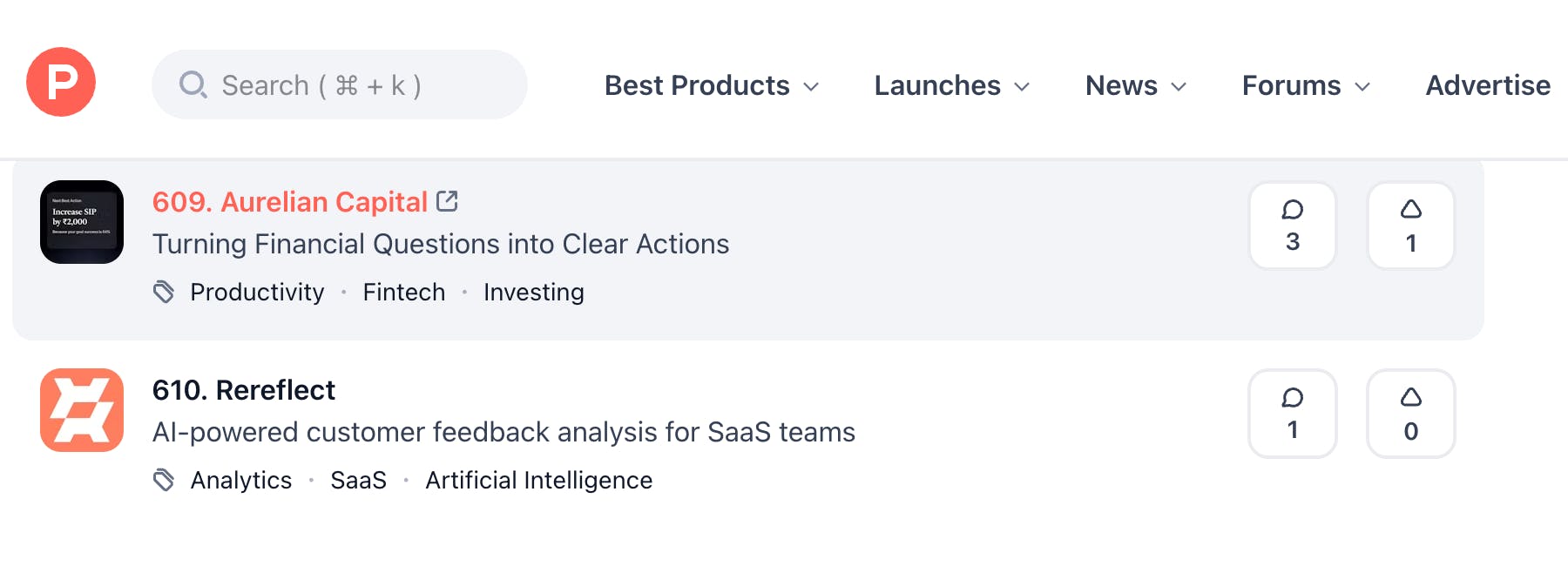
As a measure of the impact of vibe coding and the need to focus on positioning, narrative, and marketing and distribution, I noticed that that 610 products were submitted to the Product Hunt leaderboard today, but only 16 were featured which is less than 3%.
The previous high was just over 500 products in December.
In our recent Ting v2 launch, we talked about giving your calendar your brain so it can make decisions for you. That means moving from reactive proactive full automation.
Hopefully this isn t your second Ting notification overload in a couple of days
We got top three launch for the day yesterday! We're so delighted and grateful. Thank you for upvotes, comments, good vibes and giving us the energy to keep pushing.
We said we d give Product Hunt something extra, but we didn't want to spam yesterday.
One of the coolest parts of my job is getting a front-row seat to how @marianaprazeres thinks about AI. Memory feels table stakes in AI right now. But for @Meet-Ting, it s not just a log of the past - it s a living system that shapes how people schedule, work, and want to spend their week. It s not just logistics - it s patterns around energy, priorities, and relationships over time.
Here are a few things we learned while designing and testing agent memory in production:
As leaders, we spend most of our time pouring into others. Our families, our friends, our teams. We invest our time, energy, and presence in being there for others. But somewhere along the way, it becomes easy to overlook an important question
Every year I reflect on how I spent money in the previous year. Previously, I have manually scraped my bank statements and put together a report, but 2025 was interesting because I built a fairly overkill personal finance product to make this report easy to generate for myself.
Because it is really easy, I m going to do a deep dive on how I spent money in 2025. (I was able to put this all together in ~10 mins)
I wrote a long essay following a talk I gave at AI DevCon in Brooklyn last month.
It starts out with an anecdote about hunting ChatGPT in December 2022 and goes on to explore what I think will be necessary to thrive as code becomes a commodity:
In December 2022, I hunted ChatGPT on Product Hunt.
It ranked #1 product of the day, then the week, and went on to be named Product of the Year.
Having co-founded a YC-backed conversational AI startup in 2018 (long before LLMs) I recognized in ChatGPT the missing ingredient that would have made that venture viable.
The future we d anticipated had arrived. I could revisit my old problem, or I could expand my area of potency by raising and deploying my own venture capital fund.
I chose the latter.
Three years later, on December 9th, I watched a 24-hour window on Product Hunt cross 500 launches roughly double what I observed throughout the preceding 825 days. Only 13 were featured; most were unremarkable.
The LLM has fundamentally shifted the economics of software development.
As someone with a dual vantage point being the #1 Product Hunter while investing in AI startups I watch the floodwaters rise in real-time.
What s become clear: SaaS is dying; VC is withering . Building software is not uniquely compelling. Code has become a commodity.
What most people miss about commoditization is that when a product or resource becomes abundant, it doesn t just get cheaper. It unlocks new and previously uneconomic uses.
I think it was Robert Kiyosaki who said that straight-A students end up working for C students, and B students work for the government.
On the other hand, we often see stories of college dropouts building billion-dollar companies. But these next big thing cases are maybe 2% at most. I believe top students usually find their place in more formal paths: becoming doctors, lawyers, and similar professions.
TechCrunch shared an excerpt from a roughly 30-minute panel featuring Sam Altman, where he mentioned that within the next two years, they plan to introduce hardware built by their AI company.
It s supposed to be: "screenless" and pocket-sized offering a calmer experience than smartphones
avoiding constant notifications and attention overload
I put together a digest of the last few months building Ting - the good, the meh, and the lessons I can imagine me wanting to tell future founders so they can dodge the bruises and get to the good stuff quicker...
The good: - Nearly 1,000 users - ~50% MoM growth with no ads. - Added Outlook, Teams, Zoom + multi-calendar. - Launched Memories, micro product moments when the AI remembers small details + you feel seen. - Team is now 2 founders, 2 engineers, AI QA + day-one consultant. Oh, and a baby was born yesterday! - Inbound pilots from a top 10 tech company, top 3 ad network, top 3 bank. - Great investor convos at Web Summit + SF.
I've noticed that more and more founders are building their personal brand and prioritising it over building their company's brand (the company account then just reposts the founder's thoughts).