


How I spent ten years on 18 projects to understand the fundamental rule of startups

My journey in startups began 10 years ago, and I've launched 18 startups, most of which failed. Briefly on why they failed:
1. 🪦 «Contract Online» — my first startup in 2015, which was supposed to be an online service for remote signing of contracts for any transactions between individuals. A kind of analogue of a secure transaction. For this startup, I even managed to attract a business angel who invested $16,500.
Reason for failure: I had two lawyers on my team who discovered in the process that the legal framework at the time could not provide reliable grounds for protecting our users in remote transactions. The contracts would not have been considered legally signed.
2. 🪦 «Natural Products» — In 2015-2018, I became very passionate about healthy eating, but in the process, I discovered that products in all chain stores are full of chemicals, and stores with truly natural products are inaccessible to the majority. Hence, the idea emerged to create my own online platform where you could order natural products directly from farmers at affordable prices.
Reason for failure: For several years, I tried to launch this project, even trained as a baker of natural bread and tried to create my own farm, but in the process, I found that few people are willing to pay for truly natural products, even if these products were only 20-30% more expensive than market prices, and not 2-3 times more, as in premium stores. Hence, the market was so small that all my attempts were doomed.

3. 🪦 «Revolutors» — In 2018-2019, I decided to follow my love for music and release my «revolutionary» headphones onto the market at affordable prices. By working directly with manufacturers from China, I managed to create my own headphone brand, truly «packed» with advanced functionality for that time.
Reason for failure: Due to its functionality, the product's cost was above average, and this is a segment with really strong competition, which is why I didn't have enough of my own and borrowed funds for quality promotion and fighting monopolists. At that time, I lost all my savings and was left in debt.

4. 🪦 «Mefody» — In 2019-2022, I decided to go into online education and create a «revolution» by building a platform where you could buy or sell individual lessons, not entire online courses. The idea was that a user could assemble their cart only with the lessons they really needed, without buying the entire online course.
Reason for failure: Despite interest from users, unfortunately, the market was not ready for such a concept, and everyone wanted to buy entire online courses to be «led by the hand» to the desired learning goal. This is because it was easier and more familiar for people. State school and institutes formed such an educational experience for most people on the planet. A pivot towards selling any content at all didn't help the startup because there were already many strong competitors there (e.g., Patreon).
It was painful because I was counting on the success of this project the most and even, together with my partner, paid two developers who helped us build the product. My financial resources were reset again.

5-14. 🪦 «Mefody Consultations», «Mefody AI», «Pravker», «BuilderCourse», «Kevin AI», «Klark», «Case500», «Therus», «CalcSite», «SuperDrooper» — From 2022 to 2023, I decided to quickly test product hypotheses through real launches, spending no more than 2-3 months per product, testing real demand. In the end, everything went badly. Either nobody needed it, or I realized that I myself was no longer interested in continuing something, mainly because it was a small market. But the main reason: nobody or almost nobody needed it.
—————————
💡 Turning point in 2023. After 14 failures, I took a break to understand what I was doing wrong. I came across an essay by Paul Graham who argued that you shouldn't search for or invent ideas, but should look for problems around you to create a startup that will truly come to life and be needed by people.
—————————
15. 🚀 «Moment87» — In 2023-2024, I found a problem with my wife, who was tired of Instagram turning into a noisy place with an emphasis on video, polished content, advertising, and bloggers who only do business with their audience. She missed the focus only on simple photos (like Instagram in 2012), general simplicity, and a warm, cozy community. We managed to do it.
Hooray, the project came to life and got real and very satisfied users. This project has been alive for almost 1.5 years now. There are active users who love this product. Unfortunately, the market turned out to be small, and it became a niche product. Or perhaps the market isn't ready for such a product yet, or there weren't enough resources for promotion. But even now there is small monthly organic growth. We'll see what happens next.

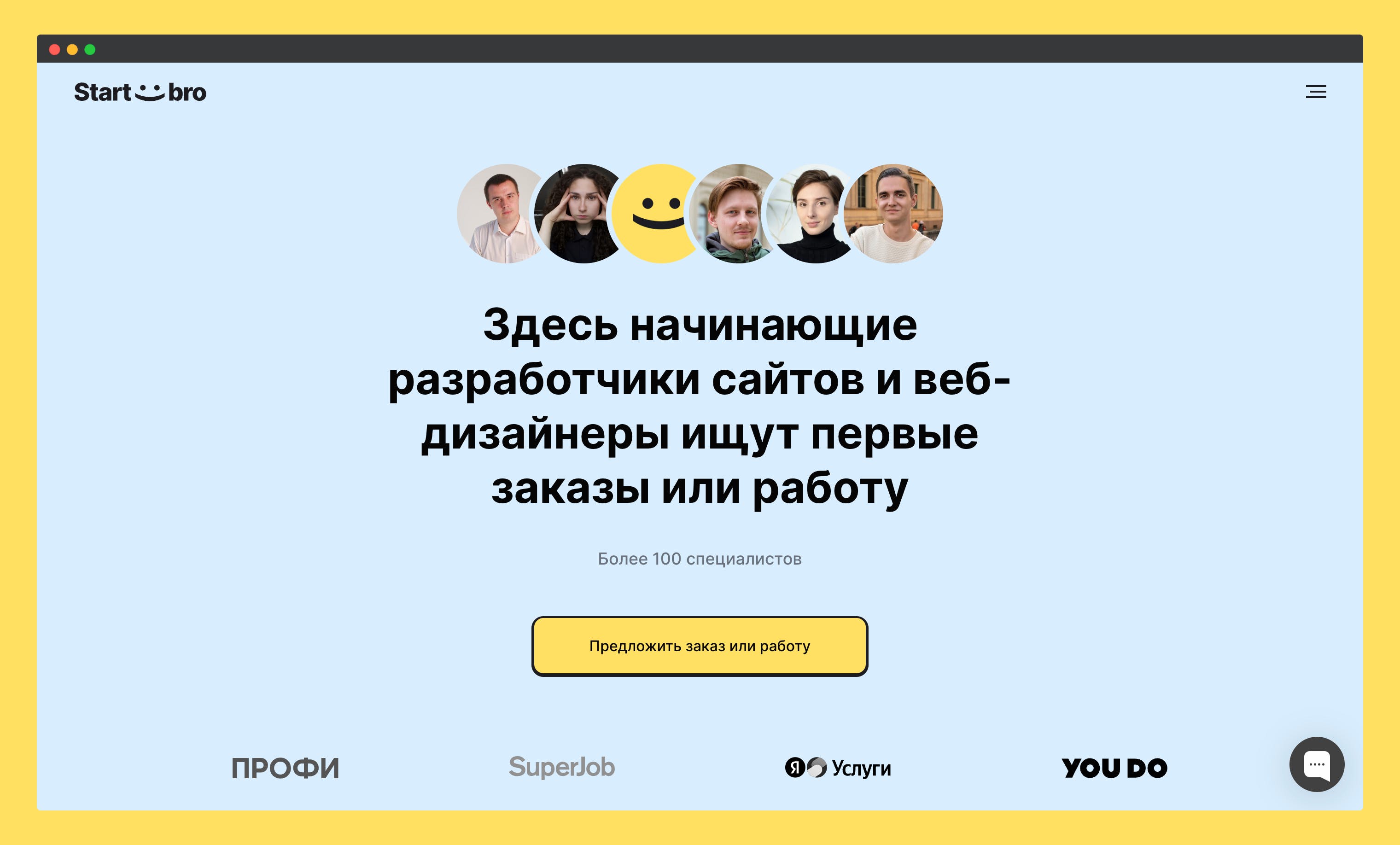
16. 🚀 «Startbro» — In 2024, I found a problem with my younger brother, who decided to try his hand at creating websites and entering a freelance exchange, but encountered the «newbie problem». Most clients bypassed him, and experienced, popular website creators with many reviews outbid him. So I created a platform where beginner freelancers could get their first orders, and clients could save on services.
Hooray, this project also came to life and got real and very satisfied users. Organic growth began among freelancers. Orders started coming from real clients (we received about 300 orders from them). But, unfortunately, my brother didn't want to develop further in this direction, and I personally didn't enjoy this project, so I had no motivation to develop this startup without him. I handed this startup over to an acquaintance, but he also for some reason didn't want to develop it. If anyone is ready to develop this project long-term, I highly recommend paying attention to this idea.
17. 🚀 «Arvess» — In 2025, continuing the search for problems, I found a problem with a friend regarding importing designs from Figma to the Tilda website builder. It turned out there was no properly working solution for this task. We created this product together, and literally within a few weeks, we got our first paying users. Now I have stepped away from this project, leaving myself a small share, because I decided to focus on my latest and current startup — ProblemHunt.
18. 🦄 «ProblemHunt.pro» — In mid-August 2025, I am launching this startup. It solves my personal problem: I couldn't find more unsolved problems from real people, preferably problems that people are willing to pay to solve, in order to create a startup based on them that would immediately generate money. Hence, this platform emerged where you can find such problems.
In the process, it turned out that this is exactly the product I want to work on for many years, and I really enjoy it because I saw how many startup founders make the same mistakes as I did. It doesn't bring in money yet, but I didn't plan to monetize this product until October 2026. We'll see what happens next.

My conclusions over the years:
You need to look for real problems around you, not ideas. And specifically those problems that people are willing to pay money or time to solve.
Only do what you truly enjoy (meaning solving certain types of problems), so that you can stick with something for a long time despite the upcoming difficulties.
If you have big ambitions, the size of the market matters. But in my experience, it’s difficult to estimate the market size with certainty if you are creating something that has not yet been created or has not gained sufficient popularity. If you see that the market is small, don’t get discouraged — if it is growing, that’s a good signal.
Boris, founder of ProblemHunt. And thank you to my wife Victoria for being with me and supporting me all these years. ❤️

Replies
I see, a problem that you faced being solved in each & every new project! and that's really great approach I think.
ProblemHunt
@akash_03 Thank you, my friend!
Triforce Todos
18 attempts means 18 times you chose courage over comfort. That’s the mindset that eventually wins.
ProblemHunt
@abod_rehman Friend, you wrote that right on point. It really gets very hard at times, but I agree, the main thing is not to give up.
MultiDrive
That's really cool that you sincerely share your wins and failures, showing the behind-the-scenes side of success. It's inspiring!
@tetiana_hryshmanovska I've posted self-introductions, product descriptions, and product discussions—none of them contain any links—yet they still won't publish. How can I resolve this?
ProblemHunt
@tetiana_hryshmanovska Thank you very much, Tetiana. I really hope it was helpful 😊
What a journey, with such clarity. The shift from inventing to spotting real problems is a powerful lesson, thank you for sharing. I could connect with Moment87, since I also liked the classic Instagram vibe.
Alos, I use ProblemHunt every morning after checking my mail, super useful!
ProblemHunt
@iamrajanrk Wow! Thank you, my friend, and I'm really glad that you find ProblemHunt useful :)
Instruct
This is a beautiful story of entrepreneurship, I wish you success with ProblemHunt!
ProblemHunt
@mikolaj_kacki1 Thank you for such kind words, it reinforces!)
“Only do what you truly enjoy, so that you can stick with something for a long time despite the upcoming difficulties.”
None of this is easy, man.
ProblemHunt
@flashidbrower Oh yeah, it's really not that simple. Especially during a long streak of failures, exhaustion, and when there's little money left in the account :)
ProblemHunt
@yara_mao Thank you! I wish you the same ⭐
Thank you so much for repeating this. I hope to finally get it in my head. I've been failing for almost twenty years mostly because I wasn't trying to solve crucial problems. Even though my startup ideas were replicated years later in the market, when I was building them the market wasn't ready. One needs to solve the problems of today not the problems of tomorrow. I was building toogoodtogo in 2014 when no one cared about food waste like today. I built powerful location based apps in 2012 but then I gave up. Most startups I created only made me see someone else do something similar years later and get financed yes, but lose a lot more money than I did, because in the end they did not work even with all the money in the world. They weren't solving a problem. Like Foursquare, they had so many users but then what were they solving? I want to add that this is true but sometimes your idea and your method does create demand and solves a problem no one thought they had, like the airplane or car. That's where the biggest innovations come from. But the risk with innovation is that people are comfort creatures and won't change unless everyone is changing. For the car many people said it was not better than a horse until 50 years later. Even Ai today has a few holdouts being critical of the service.
Yes to solving real problems, but also don't give up on your vision. Sometimes the little wins can build the big one.
ProblemHunt
@francis_osih Wow! My friend, thank you for sharing your experience and vision. I read it with great interest — gave me a lot to think about. The main thing is, never give up, and you will succeed! 🚀
ProblemHunt
@globenomad Val, thank you my friend! Good luck to you and me x1000 🚀
Great write-up!Thanks for sharing your journey.
Love how you emphasise the shift from idea chasing to problem solving.
The honesty about 18 projects over ten years is refreshing, so few founders talk openly about those early, messy attempts.
One question: now that you’ve arrived at the “right problem” phase with ProblemHunt, how will you balance founder passion / interest vs market size & monetisation?
Also curious how reflection has changed your criteria for selecting a next-project: is it more about you being the user of the problem, or others being in pain and willing to pay?
ProblemHunt
@doong_yee Thank you for such interesting questions, I'll try to answer them:
Unfortunately, I'm not sure I can give a precise answer to this question, because at different periods of my life I find myself in different states. Sometimes I want to do only what interests me, even at the expense of market size and monetization, while other times I just want to earn a lot of money. I am most likely trying to balance somewhere between these two poles right now.
Most often, I solve other people's problems because my own problems always seem insignificant or not substantial enough for me to be willing to pay to solve them.
I hope I've answered your questions. Thanks again for the questions :)