

Analytics Pitfalls & Principles
Stop making the same Data & Analytics mistakes
66 followers
Stop making the same Data & Analytics mistakes
66 followers
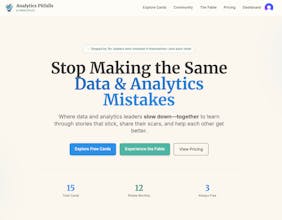
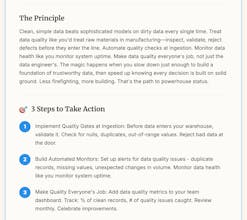
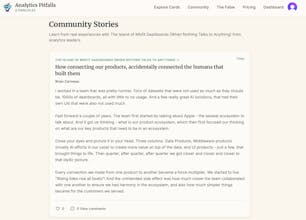
In a world of feeds and overload, this is where data and analytics leaders slow down to grow—together. Learn through stories that stick, not posts that fade. Share your scars, help others sidestep them. When you invest in your growth and help others grow, you feel better. 15 rotating cards with tactical steps. A business fable to make you feel the issues - perhaps see yourself or your team. Real stories. Slowing down—together.
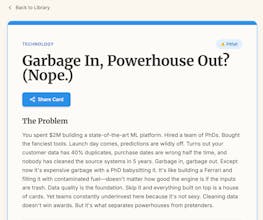




Death by Dashboard — This one hits close to home. Every dashboard starts as “high priority,” but not everything can be. When everything is a priority, nothing really is. Fewer, clearer dashboards that actually drive decisions beat a graveyard of well-intended ones every time. Less noise, more signal—and a lot less time spent keeping the lights on.
Analytics Pitfalls & Principles feels like a really thoughtful resource for anyone working with data, especially those who want to avoid common traps while making better decisions. Helping people understand core analytical principles and avoid misleading conclusions is genuinely valuable. Congrats on launching this!
It's not just one mistake; it's a treadmill of mistakes! For analytics projects, I frequently use the chess analogy (or chess data). There is a percentage attached to every move ever made by all grandmasters that tells us how many grandmasters who made any particular move ended up losing the game. It turns out there is an overwhelming number of moves (made by grandmasters!) which guaranteed 100% they would lose. For 20+ years I have tracked the mistakes that guarantee failure in analytics projects, resulting in non-adoption, distrust, disregard, or worst of all "dischampioning" (users telling other users your solution sucks). It only takes one of these mistakes to doom a project to failure, but instead of avoiding the mistakes I see a doubling-down on the quantity of projects with the same mistakes. Only by doing analytics on your own projects will you be able to identify the things that correlate with failure and avoid all of the mistakes that guarantee failure.
I love the focus. How do we move from urgency to intention? How do we move from data to insights? How do we slow down to speed up? You nailed it! Common standards that everyone is doing as a data community.