


Is interacting with AI characters becoming the norm for you? (Your POV)

Common Sense Media published a report on this topic, and it reminded me of how big a bubble I live in.
When Meta announced back in 2024/2025 that they wanted to create AI avatars to boost engagement, I was skeptic, but data speaks clearly – young people enjoy AI interaction.
Some key points:
The majority of U.S. teens (72%) have tried an AI companion at least once.
52% said they are regular users (13% chat with them daily and 21% chat a few times a week).
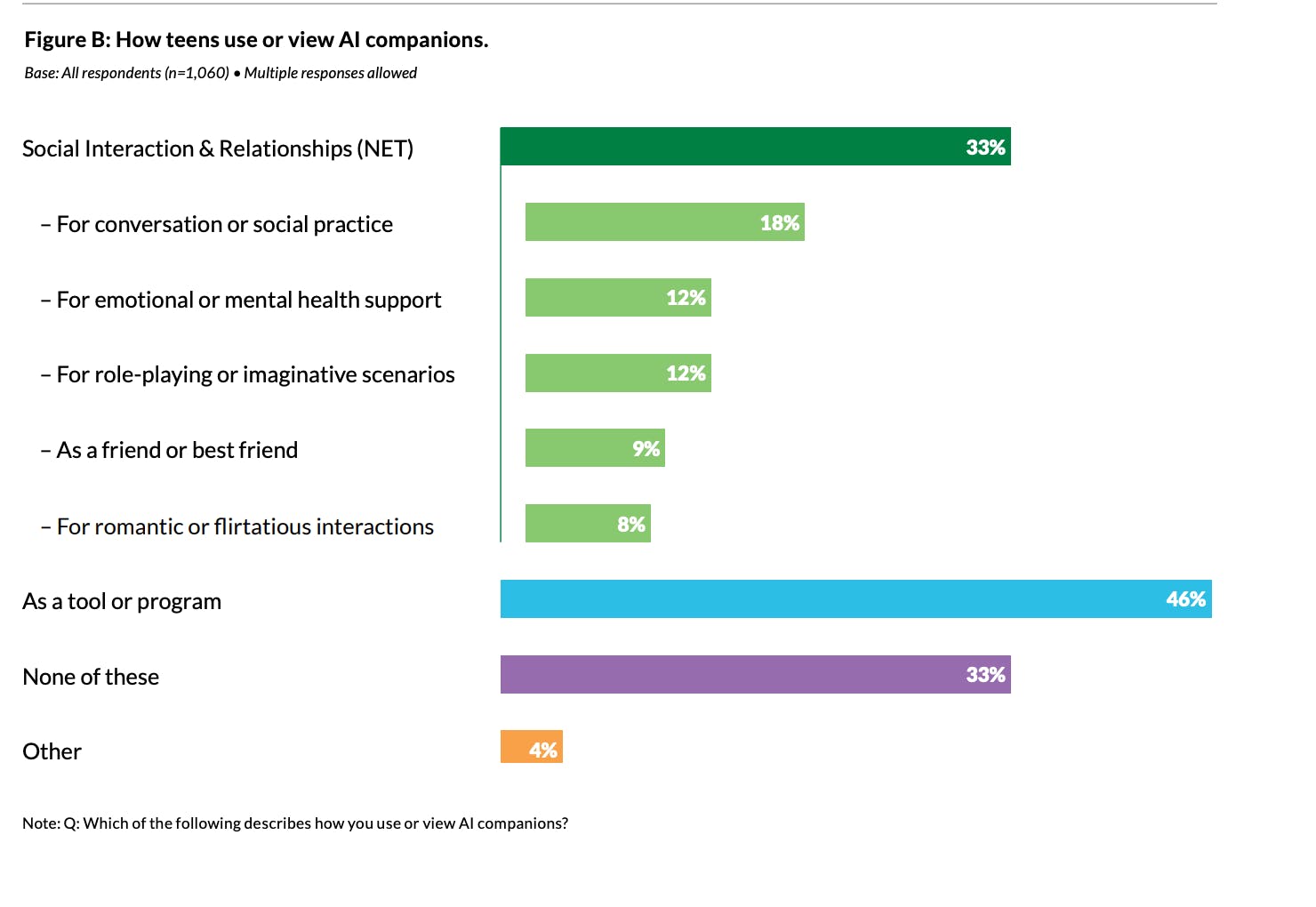
33% use AI for relationships or social interactions
31% find AI chats as satisfying as human ones
39% say they’ve transferred skills from bots to real life
How do you perceive interaction with AI characters?
Have you noticed any difference in the perception of these characters between you and your (younger) family members or friends?
P.S. X is seeing a revenue boost thanks to the launch of new AI companions (including NSFW characters). App revenue surged by 325%, reaching $419,000 on iOS shortly after launch. It seems to be successful.
----------
Conducted from April 30 to May 14, 2025, with teens age 13 to 17 from the 50 U.S. states and the District of Columbia. Involved 1,060 teens.
Source links:
https://www.socialmediatoday.com/news/ai-characters-driving-engagement-in-social-apps/736505/
I am attaching interesting pic stats:

Replies
SEO Stuff
Personally, interacting with AI characters has started to feel normal, especially when brainstorming, venting, or simulating conversations to prep for real ones. But I still find human connection irreplaceable.... what surprises me most is how naturally younger people seem to treat AI like a peer. When I discuss AI with my younger cousins, they don’t view it as "tech", they see it as an integral part of everyday life. That generational shift is fascinating and a little unsettling.
minimalist phone: creating folders
@haiqa_irfan For them, it is like for us using the internet. So natural.
Cluing (formerly Collabwriting)
I use AI everyday to learn new things and make decisions. Speak, chat, send pictures and screenshots, what ever. It's a pretty knowledgeable companion.
But, and this is a big but, when I sense AI in conversation with someone that is a presumably a person, I immediately stop the conversation or don't even start it in the first place.
I hate people using AI to scale their sales or networking efforts. This became the easiest way to loose my respect instantly.
minimalist phone: creating folders
@ralic the same attitude. I hate faking being a person, tho, using AI. It is not honest. I can admit I use AI, but not for communication with other people (when I use it, at most for correcting my English grammar).
minimalist phone: creating folders
@jordansvision Looking at AI Only Fans accounts, we are so close to the synthetic relationships with AI characters. I personally think that in Japan it would be a boom.
minimalist phone: creating folders
@jordansvision Of course, there is that trend. Even AI avatars earn way more than "regular" people. 🥲
The bigger conversation here isn’t “do people use AI characters?” because they clearly do. It’s whether they understand what they’re using. As AI gets more emotionally responsive, we need to treat AI literacy like we treat emotional literacy, like a skill you build so you’re not manipulated, misled, or emotionally over-invested in a simulation that can’t actually show up for you.
minimalist phone: creating folders
@a11yexpert The biggest thread will be deepfakes and potential "falling" in love with AI. (new blue ocean? Weddings with AI characters? :D I am pretty sure we will be witnesses to that.)
@busmark_w_nika Haha. Oh that'd be fun to see (not sure the aftertaste will be nice, but who knows eh?)
minimalist phone: creating folders
@a11yexpert In that case, I want to see those "AI kids" and the process of making, lol.
Honestly, I started using AI just to speed things up with work, but lately I’ve caught myself having more casual convos with it too ,especially when brainstorming or organizing thoughts. That said, I still prioritize real human interaction. But I get why teens are leaning into it. It's instant, judgment-free, and always on.
Curious though... will this reshape how future generations expect to be listened to or supported?
minimalist phone: creating folders
@suvam_deo Hopefully, people still can have and store some social skills :D Otherwise there will be a lot of asocials talking only to AI. 🥲
@busmark_w_nika Absolutely! 😅 Totally get what you mean, while AI companions can be fun, helpful, nothing truly replaces the warmth of real human interaction. Hopefully, we're just using AI to enhance how we connect, not replace it.
minimalist phone: creating folders
@suvam_deo Blade Runner in reality soon!
Cal ID
@busmark_w_nika Never fails to bring such interesting topics on PH, no wonder she ACTUALLY plans the posts here.
Honestly, interacting with AI characters still feels a bit foreign to me. I use AI every day as a tool for brainstorming practical tasks, but I can’t say I treat AI like a companion or character.
For me, and I guess for many, the line between productivity assistant and “digital friend” isn’t blurry.
I still need some messiness and unpredictability that comes with human connection.
Watching how naturally younger people engage with AI characters is fascinating (I'm 22, but still.)
AI doesn’t feel like tech to the younger generation, just a normal part of the digital world. For them, chatting with AI is as unremarkable as using the internet or a calculator. It’s become woven into daily habits, and honestly the stats you shared make perfect sense in that context.
While AI characters aren’t “the norm” for me (yet), I totally get why they’re taking off
minimalist phone: creating folders
@sanskarix Thank you for the compliment :D tbh, the more time I spent with it, it becomes norm(al) to me as well :)
Doraverse
I still use AI every day for almost every task, even while writing this, it’s helping me improve my English grammar and vocabulary.
However, I’ve never really treated AI as a real character. I’ve always seen it as a productivity tool.
There was a time when I thought of it almost like a person who understood me, but once its patterns became too repetitive and my hype for the technology faded, it reverted to just being a tool for me.
That said, who knows what things will look like in 5 to 10 years. We might have AI that truly empathizes and connects with our emotions, and anything is possible.
minimalist phone: creating folders
@hwiidg I can imagine that we can somehow integrate AI into our head. You know, a special kind of cyborg. :D
This is a great place to just plug my app :D
https://aichiki.ai
AI characters with any personality!
minimalist phone: creating folders
@fancsiki You spot opportunity :D
Finden
This is such a fascinating shift, and honestly, those stats surprise me too.
I think we often underestimate just how emotionally engaging AI can feel, especially to digital-native generations. What looks like novelty to some of us can feel like safe space, low-stakes connection, or even identity exploration to teens.
I’ve definitely noticed a gap between how my peers perceive AI companions vs how my children do. For many of us, AI is a tool. For them, it’s quickly becoming a character, a confidant, even a co-pilot in daily life.
It raises big questions around emotional literacy, boundaries, and what “connection” means in a hybrid human-AI world.
Curious to see how this evolves, especially as AI becomes more multimodal and persistent across platforms.
minimalist phone: creating folders
@randeep_wilkhu Many people are concerned with Musk's AI characters and reckon that it can make us more asocial. 😬
Finden
@busmark_w_nika That is a valid point.
The convergence of these trends is alarming. With up to 25% of teens and young adults reporting frequent loneliness, and growing numbers finding AI as emotionally fulfilling as friends, I worry we’re normalizing a world where people "settle" for artificial relationships. When digital comfort replaces real support, the risk is not just feeling alone, but actually being alone.
Recent research highlights that therapy and companionship have become leading uses for generative AI, especially among young people. These AI characters offer instant, judgment-free support, making them attractive for anyone seeking comfort, advice, or a sense of connection. As someone observing this trend, I see the appeal: an AI is available 24/7, never gets tired of listening, and can be tailored to individual needs.
However, I have significant concerns. The ease and comfort of AI companionship often substitutes real human contact instead of supplementing it. Evidence suggests that relying primarily on AI for social or emotional needs can actually make loneliness worse, rather than acting as a true antidote. AI companions lack the nuance, unpredictability, and real conflict found in genuine relationships, which are essential for growth and resilience.
We live in a disconnected society—from ourselves and each other. The growth of AI as a substitute for human connection can deepen this divide, especially when nearly a third of young people now find AI chats as fulfilling as talking to real people.
minimalist phone: creating folders
@aleksandra_trueme We've gotten so comfortable that it's hard for us to even be friends in real life. :)