


How a Teacher Uses AIFlow Mindmap to Transform Her Classroom - A Real-World Case Study

Introduction: The Challenge of Teaching in the AI Era
As artificial intelligence becomes increasingly accessible to students, educators face a pivotal question: What is the role of teachers when students can learn directly from AI? One innovative teacher has found her answer—not by competing with AI, but by orchestrating it.
This is the story of how she transformed her teaching approach using FunBlocks AIFlow Whiteboard and its AI-powered mindmap features, creating a dynamic learning environment that extends far beyond the traditional classroom.
The Teacher's Workflow: From Lesson Planning to Active Learning
Before Class: Rapid Lesson Preparation
For each lesson, this teacher creates a dedicated AIFlow Whiteboard (Canvas) during her preparation time. Here's her process:
AI-Generated Mindmaps: She uses FunBlocks' AI to instantly generate comprehensive mindmaps covering the lesson's key concepts and topics
Quick Customization: Rather than building mindmaps from scratch, she simply reviews and adjusts the AI-generated structure, saving hours of preparation time
Resource Integration: She adds supplementary materials—notes, web links, images, and videos—directly onto the whiteboard at strategic locations
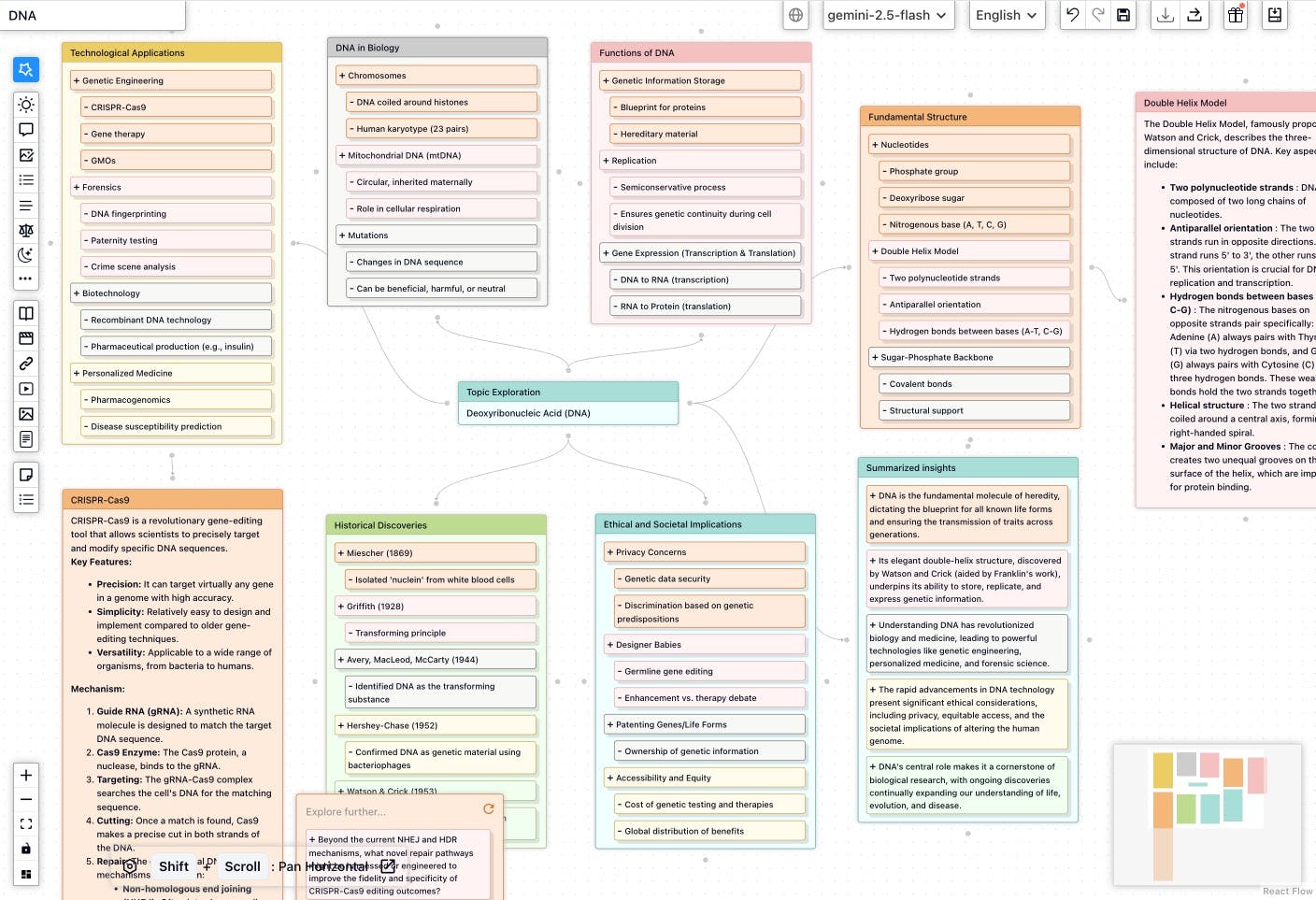
During Class: Interactive Visual Learning
In the classroom, the AIFlow mindmap becomes the central teaching tool. When students encounter complex subtopics, she leverages AI to:
Generate detailed explanations on demand
Create flowcharts to illustrate processes
Display sequence diagrams for step-by-step concepts
Show infographics to visualize data and relationships
These visual aids appear automatically in the AI-generated content, making abstract concepts tangible and easier to grasp.
After Class: Where Learning Continues
Here's where the magic happens. After each lesson, the teacher shares the whiteboard with her students. Each student can:
Clone their own version of the classroom whiteboard
Explore topics at their own pace in a personal knowledge space
Generate detailed content for subtopics that interest them
Create related questions and explore connections
Continue learning with their "AI teacher" long after the bell rings
Why AIFlow Mindmap Works: Key Benefits
1. Massive Time Savings
Traditional mindmap software requires manual creation of every node and connection. AIFlow's AI generates comprehensive mindmaps in seconds, freeing teachers to focus on pedagogy rather than formatting.
2. Comprehensive Knowledge Architecture
AIFlow mindmaps don't just cover isolated facts. They provide:
Foundational concepts for beginners
Practical applications for context
Connections to related fields for broader understanding
A big-picture view before diving into details
This holistic approach helps students understand not just what they're learning, but why it matters and how it connects to the larger world.
3. Adaptive Deep Dives
Students learn at different paces. With AIFlow, each learner can:
Expand subtopics that challenge them
Generate additional explanations in different formats
Explore tangential questions without disrupting class flow
4. Multimodal Learning Support
The automatic inclusion of flowcharts, sequence diagrams, and infographics addresses different learning styles, making complex information accessible to visual, logical, and verbal learners alike.
The Teacher's Role Evolution: From Lecturer to Knowledge Architect
This case study reveals an important shift in the teaching profession. As AI handles knowledge delivery with unprecedented breadth and availability, this teacher has redefined her role:
Traditional Role: Knowledge Transmitter
Lectures on content
Answers questions
Tests retention
New Role: Knowledge Architect
Designs learning frameworks and objectives
Constructs knowledge spaces where students and AI collaborate
Guides exploration rather than delivering information
Curates resources and creates contextual learning environments
Rather than seeing AI as a threat, she harnesses it as a co-teacher, maintaining her essential role as the human guide who provides structure, motivation, and meaning.
Practical Impact: What Changes in the Classroom?
For Students:
Personalized learning paths after shared lessons
On-demand clarification without waiting for the next class
Deeper engagement with topics that spark curiosity
Ownership of their learning journey
For Teachers:
Reduced preparation time for visual materials
More energy for interaction and guidance during class
Better insights into student interests through their whiteboard explorations
Scalable support as AI helps answer common questions
The Future of Education: A Collaborative Model
This teacher's approach offers a compelling vision for education in the AI age. The classroom doesn't end—it transforms into a hybrid space where:
Teachers design and facilitate
AI provides personalized support and content
Students take ownership of their learning
Knowledge exploration continues 24/7
The question isn't whether AI will change education, but how teachers will adapt. This case study demonstrates that with tools like FunBlocks AIFlow Mindmap, educators can remain indispensable by evolving from information sources to learning architects.
Conclusion
This teacher's story isn't just about adopting new technology—it's about reimagining what teaching means in an AI-enhanced world. By using AIFlow Mindmap to create comprehensive, shareable, and expandable knowledge spaces, she's built a classroom that never closes and learning that never stops.
The tools exist. The question is: Will you become a knowledge architect for your students?
Replies
Triforce Todos
This is the future of education: teachers as architects, not just lecturers. Brilliant case study!
FunBlocks AIFlow
@abod_rehman Thank you for your reply!
Yes, this case is an excellent example of how AI can be applied in education in the future, coming from a teacher user of FunBlocks AI. We also greatly appreciate and are grateful for such exploration!