
Launched this week

Sway
Turn spoken thoughts into clear structure.
136 followers
Turn spoken thoughts into clear structure.
136 followers
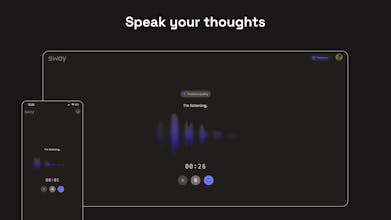
Sway is for people who think better by talking than typing. Just speak your thoughts naturally. While walking, thinking, or reflecting. Sway listens and turns what you say into clear summaries, key points, and actions. No prompts. No formatting. Just speak -> clarity.





This is a really refreshing take on note taking, capturing thoughts as they happen instead of forcing structure. I’m curious how Sway decides what to surface as a key point versus a side thought and how much control users have to shape the summaries. Could see this being a game changer for people who process ideas verbally
Sway
@copywizard Thanks, i really appreciate that.
Sway focuses less on individual sentences and more on intent over the whole thought flow. Repetition, emphasis, and where ideas turn into decisions matter more than perfectly phrased lines.
Control is intentionally light right now. We want the first summary to feel like someone who listened really well.
More ways to gently shape summaries (without turning it into prompt work) are coming.
And yes it’s built exactly for people who think out loud 🙏 😊
@christian73 I really like that mental model; ‘someone who listened really well’ is doing a lot of work here. If you ever want a second set of eyes on how that idea shows up in your onboarding or homepage, I'm happy to help shape the language so users feel that promise immediately. Either way, I'm excited to see where you take this.
Sway
@copywizard oh wow that means a lot, thanks mate.
“Someone who listened really well” is exactly the feeling we’re trying to anchor, especially early on. We’re also still learning how that promise should show up in onboarding and the homepage… so a second set of thoughtful eyes like yours would be incredibly valuable.
Really appreciate the offer and the encouragement 🙏
@christian73 Glad that resonates. I’d be happy to take a look. If it helps, I can do a quick async pass on the homepage and early onboarding and share a few concrete suggestions around language, sequencing, and expectation setting. No pressure at all, just a thinking partner lens. Want me to send a short Loom or doc
Sway
Sway
@je_suis_yaroslav Great point and totally agree. For on the go capture, friction really is everything. Shortcuts / quick access on iOS are something I’m actively thinking about, especially for moments where you just want to start talking instantly without opening an app or breaking your flow.
Right now Sway is still early, but fast, hands free capture is very much the direction. Curious: would you imagine triggering it via a lock screen shortcut, Siri, or something else entirely?
Sway
@je_suis_yaroslav and thanks for the upvote, really appreciate it 🙌 🫶
@christian73 Two blocks into a walk, I start thinking out loud, then those voice notes just sit there. Lock screen shortcut plus one tap to start capture would make Sway stick. A quick transcript edit before the summary, key points, and next steps would build trust.
Sway
@piroune_balachandran This resonates a lot !!
You’re describing exactly the moment Sway is built for.
And Lock screen / one tap capture is on our radar, and the idea of a quick transcript review before summary + next steps is a great call. 🙏
@christian73 How Sway splits key points from actions matters a lot. Auto-detection would save the most time.
Sway
@piroune_balachandran 100%, that split is crucial. Auto detection is where Sway can really save time, and that’s a big focus for us.🙂
So it's more of a notetaker rather than a writing copilot, right? I was thinking to suggest this app to our CEO for his thought leadership posting on Linkedin. The current problem is to get him into the routine, so talking when walking could defo work for him. Voice modes in ChatGPT and co could work as well, but I like the No prompts environment - keeps you focused
Sway
@yulianazarenko That’s a great way to put it. Yes, Sway is closer to a thinking / note taking companion than a classic writing copilot.
The main difference is when the structure happens.
With tools like ChatGPT, you usually still have to sit down, prompt, and “enter writing mode.”
Sway is designed for the moment before that … when ideas are still messy, spoken, and happening while walking for instance.
For thought leadership specifically, many people use Sway to:
talk through ideas on a walk
capture the core message + angle
then turn that into a LinkedIn post later or other socials (sometimes with another tool, sometimes directly)
The no prompts environment is very intentional, cause it removes friction and helps people actually build the habit first.
If your CEO thinks best while walking, this is exactly the kind of use case we had in mind 🙂
Happy to hear how it works for him if you end up suggesting it!
@christian73 Interesting! Btw what are the ways to export the notes from the app? If it is as seamless, I think we should defo try it
Sway
@yulianazarenko heyhey, right now you can export notes as clean text, PDF, Markdown (Notion/Obsidian), or Word (DOCX). And you can also share a read only link if you just want to pass the thinking along. We’re intentionally keeping exports frictionless so notes can flow easily into whatever tool you already use.
Curious to hear how it fits your workflow if you try it 🙂
@christian73 This is really interesting and immediately piqued my interest. I've been trying to solve this problem for myself as well. I've been using Google Docs audio tools to essentially word vomit into a doc and then put it into Claude to try to organize and clarify my thoughts.
@christian73 I just tested the app and I have to say that I would try it again. It took the second step out of my process by not having to then move the block of text into another AI (Claude) to get the outline output. I also didn't realize until using this app that by not seeing the words I'm saying (like I do in Docs) actually allows me to stay more present in my thoughts. I didn't realize just how much I'm still editing my thoughts and words as I'm going just because I can see the words in the Doc.
Sway
@lauren_holloway This really means a lot, thank you for sharing this so thoughtfully.
The part about not seeing the words and staying more present is exactly what we hoped people would feel. So glad it removed a step from your process 🙏🫶🏽
Migma AI
The "thinking by talking" flow really resonates. I do my best work walking too.
Love the zero-prompt approach - automatically extracting summaries/actions without asking is the right UX. How does it handle technical jargon or domain-specific terms?
Nice work!
Sway
@adam_lab Thanks a lot, really appreciate that 🙏
And love hearing that the “thinking while walking” flow resonates.
Right now Sway handles technical / domain specific language surprisingly well as long as it’s spoken naturally (e.g. dev terms, product jargon, acronyms). We don’t try to “simplify away” terminology ... the goal is to preserve intent and meaning, not rewrite it for a generic audience.
That said, there are still edge cases where very dense or highly specialized jargon can get slightly abstracted too much. Improving domain sensitivity (and letting users steer how literal vs. abstract summaries should be) is something we’re actively working on.
If you’re using it in a specific domain (engineering, product, research, etc.), I’d genuinely love to hear how it performs there. That kind of feedback is gold for us.
Thanks again for checking it out!
I’ve always felt typing slows thinking down. Something that keeps the original momentum while adding structure sounds extremely useful.
Sway
@leo_aj That’s exactly how it feels for me too.
Preserving momentum first, structure second is the core idea behind Sway. Really appreciate you sharing this.
This is an interesting idea.
By what internal model or constraint system does Sway segment spontaneous speech into ‘key points’ and ‘actions'?
does it have a summarization layer, or a safe mechanism to avoid imposing inferred narrative instead of preserving the speaker’s actual intent?
Sway
@suin_moon Great question.
Sway uses a lightweight intent-extraction layer rather than a single “hard” summarization pass. We bias toward explicit signals in the speech (commitments, decisions, open questions) and keep uncertainty when intent isn’t clear.
The goal is to preserve the speaker’s intent, not impose a narrative.