

PinMe
Publish sites in seconds, right from your browser.
398 followers
Publish sites in seconds, right from your browser.
398 followers
PinMe is the simplest way to publish your work online.
You can publish a vibe coded page, a portfolio, a landing page, a demo, or any folder of front end files. Upload in the browser or deploy with a CLI tool, and get a shareable link right away.
You do not need to create an account. You do not need to set up servers. You do not need to learn hosting. PinMe takes care of the boring parts so you can focus on making and sharing.
This is the 2nd launch from PinMe. View more
PinMe
Launched this week
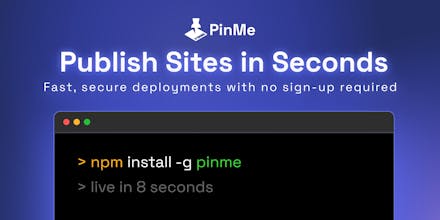
PinMe helps you publish sites in seconds.
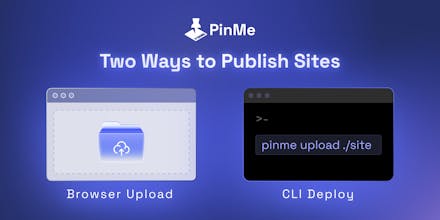
You can upload sites from your browser with drag and drop, or deploy from your terminal with a single command.
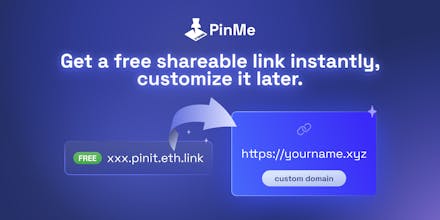
Deploy, get a link, and share. PinMe focused on a fast, clean deployment experience without locking you into an all in one platform. No accounts, no sign ups, no logins, no payments required.


Free
Launch Team / Built With


PinMe
Hello PH! This is Glitter Protocol, the dev team behind PinMe.
We’re back for round two. Thanks for checking us out and for all the feedback last time, it helped a ton. 🙌
This time, PinMe’s here to make deployment feel…not like deployment.
Yes! That means PinMe will give you a completely new experience for deployment.
What we believe is if you can build a project in minutes, getting it online should be just as quick.
PinMe keeps things simple: you can drag and drop in the browser, or deploy from your terminal with a single CLI command.
No accounts, no sign ups, no logins. Free.
Give it a spin and drop your link below. We’ll be in the replies and would genuinely love to see what you ship 🚀
Gosh can you explain how your customers can
Share links publicly without some intermediary server
Maintain security if it's truly peer-to-peer
Handle persistence when your machine is off?
Are you hosting/proxying - our "pin" data goes toy servers, you generate the share link, completely centralized
Or is It WebRTC with STUN/TURN servers - Still requires their infrastructure to broker connections? Im fascinated how :-)
PinMe
@peach_melbaz Thanks — great questions. PinMe is not WebRTC and not “served from your laptop”.
How links work:
ENS protocol stores the site pointer as a content hash (e.g., ipfs://), so the name resolves to a specific content version.
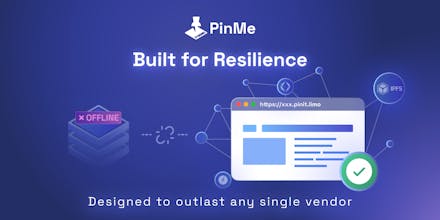
IPFS is the distribution network: gateways/IPFS nodes fetch by CID and deliver frontend resource files to browsers.
Filecoin provides durable persistence: we make sure the content is stored long-term so it remains available.
Security model:
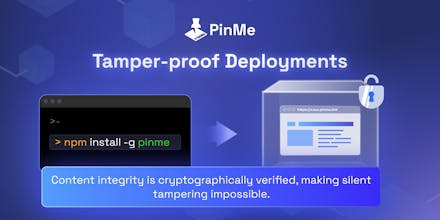
Because the link points to a CID (content-addressed), the site is tamper-evident: changing any bytes changes the CID, so the original reference won’t silently “turn into” different content. Users can also use multiple gateways to avoid trusting a single operator (you can even run your own).
Are we hosting/proxying?
Delivery happens via IPFS gateways (community and ours). It’s not a single per-site origin server, but gateways are the bridge that makes IPFS content work in a normal browser.
Hope this answers your questions, we are using crypto techs to solve some real web hosting problems.
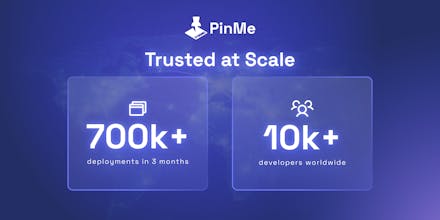
Every time I need to share a quick prototype with a non-technical stakeholder, the deploy step kills the momentum. PinMe auto-detecting build dirs and going straight to IPFS with drag-and-drop removes that friction entirely. 150k+ deploys with zero accounts is a strong signal.
Migma AI
Zero-config deployment is the dream! How do you handle environment variables and secrets without a server config?
Does it support any backend API routes or strictly frontend-only?
PinMe
@adam_lab Env vars / secrets: PinMe only ships frontend resource files. Anything embedded at build time ends up in the bundle, so you should never put secrets in frontend env vars. If you need configuration, use public env values (e.g. VITE_PUBLIC_*, NEXT_PUBLIC_*) or runtime config fetched from your backend.
Backend/API routes: PinMe is frontend hosting, not a server runtime — we don’t run API routes or SSR functions. The intended model is frontend ↔ backend: your PinMe-deployed frontend can call any backend over HTTPS (REST/GraphQL), serverless functions, or your own API.
So PinMe is best for:
frontend-backend separated apps, and
pure frontend projects
Tools that slow you down selectively are more helpful than ones that constantly interrupt.
Congratulations on the new launch! It would also be useful to have a library of templates for standard tasks.
Hey Ted - this deployment flow seems super convenient! I've noticed the comments are zeroing in on the trust/persistence questions (who’s actually hosting, what happens when the uploader is offline). Curious how much you've been considering making deployments verifiable by default (content-hash manifests / signed deployment receipts) and to offer optional persistence via user-chosen pinning providers or a simple paid “guaranteed pinning” tier. Neither of those has to change the clean UX; it just makes the underlying guarantees clearer and more robust.